Mortgage Rates USA Explained What You Need to Know

Have you ever wondered how a small change in a single rate can alter your monthly budget by thousands over time? This guide puts clear information in your hands so you can make smarter choices when you buy a home.
A mortgage rate is the percentage a lender charges to borrow money. That percent affects your monthly payment and the total loan cost. As of May 2026, the Bankrate national survey reported a 30-year average of about 6.46%.
What you pay depends on your credit score, the loan amount, and the wider economy. Securing a lower interest can save you thousands over the life of the loan.
Keep reading to learn practical steps you can take now to lower your monthly payment, understand how the interest portion works, and pick a loan amount that fits your long-term budget.
Table of Contents
- Understanding Mortgage Rates USA Explained
- How Interest Rates Impact Your Monthly Budget
- The Role of the Federal Reserve and Inflation
- Personal Financial Factors That Influence Your Offer
- Comparing Fixed and Adjustable Rate Options
- The Difference Between Interest Rates and APR
- Strategies for Securing a Lower Mortgage Rate
- Navigating the Mortgage Rate Lock Process
- Why Shopping Around Saves You Money
- Making Informed Decisions for Your Financial Future
- FAQ
Understanding Mortgage Rates USA Explained

Knowing how a lender sets your interest can change how you plan for a home purchase.
A mortgage is a long-term loan from a bank or financial institution that helps you buy a home using the property as collateral.
The interest rate is the fee a lender charges for using its money. This fee is part of your monthly payment and affects the total amount you repay.
Because most home loans last 15 to 30 years, even small shifts in the rate can change your long-term budget.
- Your monthly payment is based on the principal and the interest charged on the loan amount.
- Lenders set different offers based on business models, risk profiles, and market demand.
- Comparing options helps you find a loan that fits your budget and goals.
Quick comparison
| Lender Type | Typical Offer | What to Watch |
|---|---|---|
| Large Bank | Standard pricing, wide product range | Fees and underwriting time |
| Credit Union | Competitive interest, member benefits | Membership requirements |
| Online Lender | Fast approvals, varied pricing | Service consistency and disclosures |
| Mortgage Broker | Access to many lenders | Broker fees and transparency |
To dive deeper into how offers are priced, read this guide on mortgage rates explained.
How Interest Rates Impact Your Monthly Budget

How interest is charged each month affects both your short-term cash flow and long-term cost.
Principal and Interest Basics
Your monthly payment is split between principal and interest. Early in the loan term, most of your payment covers interest on the remaining balance.
A higher interest rate means more of your money goes to interest and less toward lowering the loan amount. For example, borrowing $200,000 at a 4% interest rate results in monthly interest calculated on the remaining balance.
Long-Term Cost Implications
Over a 30-year term, even small differences in the rate can add thousands to your total cost. Choosing a lower interest rate helps you build equity faster and reduces interest paid over time.
"By lowering the percentage you pay, you free up money to invest in your home or savings."
Fees like closing costs are separate from interest but still affect how much cash you need at closing. Understanding these elements helps you pick a monthly payment that fits your budget and goals.
- Your payment = principal + interest; higher interest shifts money toward interest.
- Term length (15 vs 30 years) plus the rate sets total interest paid.
- Lower interest rate = faster equity build and lower lifetime costs.
| Item | Short-Term Effect | Long-Term Effect | What to Watch |
|---|---|---|---|
| Higher rate | Higher monthly interest | More total interest paid | Shop lenders and compare offers |
| Lower rate | Lower monthly interest | Faster equity gain | Improve credit, increase down payment |
| Shorter term | Higher monthly payment | Much lower total interest | Ensure monthly budget can handle payments |
| Fees & closing costs | Upfront cash needed | Adds to overall cost | Ask for itemized estimates |
For broader context on how shifts in interest affect housing affordability, see this piece on the interest rates impact on housing market.
The Role of the Federal Reserve and Inflation
The path of inflation and central bank policy together guide how expensive credit becomes for consumers.
April’s consumer price index rose 3.8% year-over-year, well above the Fed’s 2% goal.
The Federal Reserve does not set home lending figures directly, but its decisions on the federal funds rate shape market trends. When the funds rate moves, banks and investors react. That reaction influences the interest rate you see on new loans.
Higher inflation often pushes lenders to demand higher returns. If the federal funds rate rises, banks may pass costs to borrowers, increasing your monthly payment.
Economic Indicators and Market Trends
Employment, growth, and bond market appetite all matter. Strong demand for credit can lift yields on mortgage-backed securities, which in turn nudges consumer offers upward.
"Watch Fed policy and inflation data they help explain why offers move across the year."
For a clear primer on how monetary policy works, review the Federal Reserve’s own guide on Federal Reserve monetary policy.
Personal Financial Factors That Influence Your Offer
Your financial snapshot credit, debts, and savings shapes the offers you’ll receive from lenders.
Credit score matters most. A higher score usually puts you in line for a lower interest rate and a better monthly payment. Lenders use your score to judge risk.
Your debt-to-income ratio shows how much of your pay is tied to other loans and bills. A lower ratio improves the chance of a favorable rate and a smaller payment.
A larger down payment reduces lender risk. That often translates to a lower percentage charged on the loan and less interest over time.
- Credit history predicts future behavior, so clean, long records help your case.
- Each lender evaluates profiles differently, so shopping matters.
- The size of the loan versus your income also influences the rate offered.
"Maintain strong credit and a low debt load to improve your odds of a competitive offer."
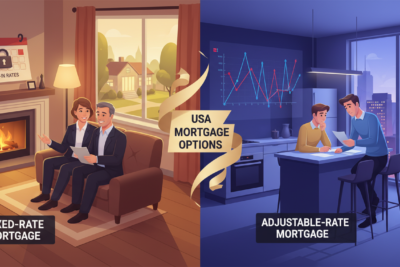
Comparing Fixed and Adjustable Rate Options
One choice gives you payment certainty for decades; the other can start cheaper but may climb later.
Before you pick, think about how long you will keep the home and how much unpredictability you can accept.
Benefits of Fixed-Rate Loans
A fixed-rate loan locks the interest rate for the full term, so your monthly payment stays steady. This predictability helps you budget and plan long-term.
Fixed loans protect you if the market pushes rates higher in future years. For example, if you expect to stay in the home a long time, a fixed option can save you stress and surprise increases.
Risks of Adjustable-Rate Mortgages
An ARM often begins with a lower introductory rate, which can mean smaller payments early on. That can suit you if you plan to sell or refinance before adjustments start.
But the main risk is volatility: after the initial period, the rate can reset based on market indexes and caps. That change may raise your monthly payment significantly.
"Choose the path that matches your time horizon: stability for long-term stays, flexibility if you expect short-term moves."
- Fixed: steady payment, protection from rising rates, simple budgeting.
- ARM: lower initial cost, risk of future payment increases, requires careful term review.
- Compare caps, adjustment frequency, and the maximum percentage change on any ARM.
| Feature | Fixed | Adjustable (ARM) |
|---|---|---|
| Initial interest | Higher or market-aligned | Lower introductory percentage |
| Payment predictability | Very high | Variable after initial term |
| Best for | Long-term owners | Short-term owners or planned refinancers |
| Key risk | Opportunity cost if rates fall | Payment shock from market moves |
To review how these options compare in detail, see a clear comparison of fixed vs ARM choices and a practical guide on fixed versus variable loans.
The Difference Between Interest Rates and APR
A simple interest rate shows the percentage charged on the loan amount, but it does not tell the whole story.
APR combines that percentage with extra fees and required charges. That includes discount points, origination fees, and some types of insurance that the lender requires.
Because APR factors in these costs, it is usually higher than the interest rate. Use APR to compare offers fairly.
- Look at both the interest rate and the APR on your loan estimate.
- Low quoted rates can hide high fees that raise your total cost.
- Closing costs typically run 2% to 5% of the loan amount and feed into the APR.
"Focus on APR to avoid being misled by a low advertised percentage."
Always ask for a clear breakdown of fees included in the APR. If you want a primer on core terms, review this mortgage basics to sharpen your comparison skills.
| Item | Shows | Why It Matters |
|---|---|---|
| Interest rate | Annual percentage on principal | Sets monthly interest portion of payment |
| APR | Rate plus fees and points | Reveals total borrowing cost |
| Closing costs | Upfront fees (2%–5%) | Increase cash needed at closing and APR |
Strategies for Securing a Lower Mortgage Rate
Smart prep work before you apply often yields a noticeably better offer from competing lenders.
Focus on clear, concrete steps that reduce lender risk and improve your negotiating position.
Improving Your Credit Score
A higher score makes you look safer to lenders. Pay down high balances, fix errors on your report, and avoid new loans before closing.
Even small score gains can change the interest rate you qualify for and shrink your monthly payment.
Increasing Your Down Payment
Putting more money down lowers the loan-to-value amount. Lenders see less risk and may offer a better rate.
Aim for a larger down payment if it won’t deplete your emergency savings. The trade-off is fewer fees over the life of the loan.
Utilizing Discount Points
Points let you prepay interest to buy a lower percentage for the term of the loan.
Assess how long you will stay in the home: points pay off only if you keep the loan long enough.
"Shopping multiple lenders can pay off research from Freddie Mac shows it may save you over $1,000 a year."
Shop and compare. Take time to get offers from several lenders and read the loan estimates side by side. For practical tips on locking the best offer, see getting the lowest mortgage rate. And if you are early in the process, review guidance on preparing to buy a house.
| Strategy | What to Do | Benefit |
|---|---|---|
| Improve credit | Pay balances, fix errors, avoid new debt | Better interest eligibility, lower monthly payment |
| Increase down payment | Save more before closing | Lower loan amount and lender risk |
| Buy points | Pay upfront to reduce percentage | Lower long-term interest if you stay long enough |
| Shop lenders | Compare multiple written offers | Potentially save $1,000+ per year |
Locking a rate gives you a short window of certainty while your loan moves through underwriting. A typical lock lasts 30 to 45 days and guarantees the interest rate your lender quoted.
This protection shields your monthly payment from sudden market swings. Most lenders offer a standard lock at no charge, but extensions can carry extra fees or higher costs.
Be aware of trade-offs. If interest rates fall before closing, a locked percentage may keep you from benefiting unless your lender offers a float-down for a fee.
Always ask your lender about the exact term, any extension costs, and float-down rules. Read the lock agreement so you know the risk and the fees involved.
"A clear rate lock helps you budget with confidence during the final steps toward homeownership."
- Confirm lock length and costs with your lender.
- Weigh float-down options if you want downside protection.
- Use the lock to protect your expected monthly payment and closing plan.
Why Shopping Around Saves You Money
Comparing offers from several lenders can turn a small percentage difference into real annual savings.
Each lender prices loans differently based on business goals and current market demand. That means the same loan amount can carry a different rate, fees, and overall cost depending on who you ask.
Research shows that comparison pays. Freddie Mac data suggests shopping can save you more than $1,000 a year. Over time, that adds up to thousands of dollars in your pocket and lower monthly payment.
Look beyond the headline interest rate. Compare APR, origination fees, discount points, and any other charges. A lower quoted percentage can hide high fees that raise your true cost.
Use multiple written quotes to gain negotiating power. A local credit union might offer a more competitive mortgage than a national bank, for example. Gathering options helps you pick a lender with clear fees and terms that match your time horizon and budget.
"Shopping multiple lenders can save you over $1,000 a year."
- Compare rate, APR, and fees side by side.
- Ask each lender for a written loan estimate.
- Negotiate using competing offers to lower your cost.
Making Informed Decisions for Your Financial Future
Take action now. Good planning today can cut decades of extra interest and free up money for other goals. Keep your credit strong, reduce debt, and compare offers from multiple lenders to improve your position.
Watch the federal reserve and inflation trends so you can anticipate market moves. Choose a fixed loan if you want payment stability or an ARM if you accept short-term savings with future risk. Consider buying points or increasing your down payment to lower your interest cost over time.
If conditions change, refinancing may make sense. For a clear view of how shifts in market percentage affect your borrowing, read this guide on how rates affect your loan and this mortgage interest primer.
FAQ
What is the difference between an interest rate and APR?
The interest rate is the percentage charged on the loan balance each year. APR (annual percentage rate) includes that interest plus most lender fees and some closing costs, giving you a clearer measure of the total yearly cost. Use APR to compare offers from different lenders and understand the true cost of borrowing over the loan term.
How does the federal funds rate affect your mortgage offer?
The federal funds rate, set by the Federal Reserve, influences short-term borrowing costs across the economy. When it rises, banks often increase lending costs, which can push up the interest you pay on a new loan or adjustable products. Lower federal funds rates usually help push lending costs down over time, reducing your monthly payment potential.
What personal factors most affect the interest you’re offered?
Lenders evaluate your credit score, debt-to-income ratio, employment history, and down payment amount. Strong credit, low debt, steady income, and a larger down payment reduce lender risk and typically secure a lower interest and better terms.
How does your credit score change what you pay each month?
Higher scores qualify you for lower interest percentages. Even a small drop in rate can lower your monthly payment significantly over a 15- or 30-year term. Improving your score before you apply often yields measurable savings.
Why should you compare fixed-rate and adjustable-rate loan options?
Fixed-rate loans lock one interest percentage for the life of the loan, providing payment stability. Adjustable-rate loans start with a typically lower initial rate that can rise or fall with the market after a set period. Choose fixed if you want predictability; choose adjustable if you expect to refinance, sell, or benefit from potential rate drops.
What are discount points and when should you buy them?
Discount points are prepaid fees you pay at closing to lower your interest rate. One point usually equals 1% of the loan amount and cuts the rate by a fixed amount. Buy points if you plan to hold the loan long enough to recoup the upfront cost through lower monthly payments.
How does inflation impact long-term loan costs?
Inflation erodes purchasing power and generally pushes market interest rates higher. Lenders demand higher returns to offset inflation risk, which can increase rates and the total cost you pay over the loan period.
What is a rate lock and why does it matter?
A rate lock guarantees a specific interest percentage for a set period between application and closing. It protects you from market increases but may have a fee or expiration if closing is delayed. Lock when you see a competitive offer and your closing timeline is secure.
How do loan term and amortization affect long-term cost?
Shorter terms (e.g., 15 years) carry higher monthly payments but much lower total interest paid. Longer terms (e.g., 30 years) reduce monthly cost but increase total interest. Amortization schedules determine how much of each payment goes to principal versus interest over time.
Can you negotiate fees and get a lower overall cost?
Yes. You can negotiate lender fees, ask for seller concessions, or choose lenders with lower origination charges. Comparing multiple offers and requesting a loan estimate from several lenders helps you identify negotiable items and save money.
What role do lenders’ risk assessments play in pricing?
Lenders price offers based on perceived borrower risk. Factors like low credit score, unstable income, small down payment, or high loan-to-value ratio increase perceived risk and lead to higher interest or added fees to offset potential default.
How do points, fees, and insurance change the effective cost?
Points and origination fees add upfront cost but can lower your interest. Mortgage insurance and property taxes add to monthly obligations. Compare total monthly payment and APR to understand how fees and insurance change your real cost.
When should you refinance to get a lower interest?
Consider refinancing when market interest drops enough to lower your monthly payment or shorten your term, and when expected savings exceed closing costs. Also refinance to switch from an adjustable to a fixed product if you want stability.
How does down payment size influence the percentage you pay?
A larger down payment reduces the loan-to-value ratio, lowering lender risk and often qualifying you for a lower percentage. It can also help you avoid private mortgage insurance on certain loan types.
What market indicators should you watch to time your application?
Monitor the federal funds rate, Treasury yields, inflation reports, and employment data. These indicators drive market expectations and can signal when borrowing costs may rise or fall.
If you want to know other articles similar to Mortgage Rates USA Explained What You Need to Know You can visit the category Mortgage.
Fixed vs Adjustable Mortgage USA How to Choose Yours

How Interest Rates Work USA What You Need to Know
Top Factors Affecting Mortgage Rates USA
Fixed vs Variable Rates USA What You Need to Know

Understanding APR in Mortgages A Beginner’s Guide

FHA loans explained USA What you need to know
Leave a Reply
VISIT THESE INTERESTING ARTICLES📚