

How to Compare Mortgage Rates to Find the Best Deal

Curious which offer will save you the most money over decades? That single question matters the moment you start hunting for a new home.
As of May 19, 2026, the national average 30-year fixed rate sat at 6.58%, a figure that reflects current economic pressures and inflation. This number shows why you should take time when choosing a loan.
You’ll find each lender sets unique mortgage rates based on business needs and risk models. By reviewing multiple offers today, you can protect your budget and avoid costly surprises over the life of your loan.
Our guide lays out simple steps you can use right away, including how to read loan estimates and weigh interest, fees, and terms. For a deeper look at fixed versus adjustable options, see this clear comparison on fixed vs variable mortgages.
Table of Contents
- Why You Should Compare Mortgage Rates
- How to Compare Mortgage Rates Effectively
- Understanding the Role of Your Credit Score
- Evaluating Different Types of Home Loans
- The Difference Between Interest Rates and APR
- Factoring in Closing Costs and Lender Fees
- Strategies for Negotiating Better Loan Terms
- Preparing Your Finances Before You Apply
- Securing the Best Deal for Your Future Home
- Frequently Asked Questions
- FAQ
Why You Should Compare Mortgage Rates

Shopping several lenders can save you more than $1,000 a year, according to Freddie Mac. That kind of annual relief adds up over decades and can affect your monthly budget and long-term wealth.
Global events and economic data push interest higher. Nicole Rueth of CrossCountry Mortgage links current rate pressure to the conflict in Iran and rising oil prices. Sean Salter at Middle Tennessee State University notes that inflation readings keep upward pressure on offers from different lenders today.
Comparing loan options gives you negotiating power and helps you avoid paying extra for the same loan features. Even a small change in rate can mean thousands of dollars saved on a 30-year home loan.
- Shop multiple lenders for leverage and better terms.
- Watch headline drivers like oil and inflation that affect interest.
- Use tools and disclosures to check fees and the long-term cost.
For key borrower facts, review the loan facts booklet.
How to Compare Mortgage Rates Effectively

Collecting multiple loan quotes gives you the clearest view of real costs and fees.
Start with at least three written offers. Match the same loan amount and term when you review them. That makes the interest and fee comparisons accurate and fair.
Gathering Multiple Loan Quotes
The Bankrate Mortgage Rate Variability Index reads 3 out of 10, which means offers are relatively stable today, but you still should shop. Look at the interest rate and the APR, plus origination fees and points.
- Compare interest, fees, and closing costs for the same loan amount.
- Check whether buying points lowers your monthly payment enough to justify the upfront cost.
- Confirm lender disclosures match across estimates.
Researching Reputable Lenders
Borrowing money is a major commitment. Read customer reviews, check licensing, and verify credentials before sharing personal data.
"By comparing different options, you can find the best lender who offers terms that align with your financial goals and home ownership timeline."
| Lender Type | Typical Fees | When to Consider | Notes |
|---|---|---|---|
| Bank | Low–medium | If you value branch service | Good for steady borrowers |
| Credit Union | Low | Members with strong credit | Often lower interest and fees |
| Online Lender | Medium | Fast processing and competitive offers | Compare disclosures carefully |
Tip: Use a trusted guide when you need a checklist for offers. See practical steps at Bankrate's comparison guide and review affordability basics at home affordability basics.
Understanding the Role of Your Credit Score
Your credit score and debt picture shape the offers you receive for a home loan. Lenders use that score as a quick measure of risk when setting an interest rate and the mortgage rate you see.
Higher scores typically earn lower interest and can cut thousands from total loan interest over decades. You also want a solid debt-to-income ratio. Lenders use it to judge whether your income covers monthly payments.
Be aware: a lender will run a hard inquiry when you apply, which may cause a small, temporary dip in your score today. Check your credit reports first and fix any errors that could hurt your borrowing power.
"Maintaining a strong credit profile gives you more choices and better terms from lenders."
- Keep balances low and pay on time to improve your score.
- Review reports for mistakes before you submit an application.
- Watch your debt-to-income ratio as you plan the loan amount.
For a clear explanation of credit effects on the mortgage rate, see how credit affects mortgage rate.
Evaluating Different Types of Home Loans
Different loan products suit different budgets, timelines, and credit profiles. Start by matching your goals with the loan features you need.
Conventional vs Government Backed Loans
Conventional loans often require higher credit and larger down payments but grant more options for terms. FHA loans and VA loans carry looser credit standards and lower down payment rules for eligible borrowers.
Fixed vs Adjustable Rate Mortgages
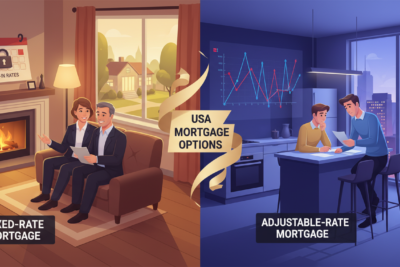
A fixed-rate option locks your monthly payment for the life of the loan, giving stability. Adjustable-rate mortgages can offer lower initial interest but may reset later, which affects monthly payments and total interest.
Conforming vs Jumbo Loans
Conforming loans meet limits set by agencies like Fannie Mae. If your purchase needs a larger amount, a jumbo loan covers higher-priced homes but usually needs stronger credit and a larger down payment.
- Match loan type to how long you will stay in the home.
- Confirm credit and income rules with your chosen lenders.
- Factor down payment, interest rate, and total interest over time.
| Loan Type | Key Benefit | Typical Requirement | Best When |
|---|---|---|---|
| Conventional | Flexible terms, no federal insurance | Good credit, moderate down payment | You have strong credit and stable income |
| FHA / Government-backed | Lower down payment, easier credit | FHA insurance or VA eligibility | Lower credit scores or smaller down payment |
| Adjustable-rate | Lower initial rate | Ability to accept future changes | Short ownership horizon |
| Jumbo | Finances high-priced homes | Higher credit, larger down payment | Purchase exceeds conforming limits |
"Choosing the right loan starts with knowing your timeline and credit profile."
For a current snapshot of national mortgage rates and a detailed list of types of mortgage loans, check those resources when you shop offers today.
The Difference Between Interest Rates and APR
Interest rate and APR are related, but they measure different pieces of what you pay for a loan.
The interest rate shows the percentage charged on your principal. It affects the monthly payment and the life of the loan.
The APR (annual percentage rate) adds lender fees and some closing costs into a single annualized figure. That makes the APR a broader measure of the total cost of borrowing.
- Look at the interest rate for monthly payment estimates.
- Use the APR to judge true affordability and long-term cost.
- Watch advertised low rates that pair with higher fees; APR reveals that trade-off.
| Metric | Shows | Best for |
|---|---|---|
| Interest rate | Percent on principal | Monthly payment math |
| APR | Interest plus lender fees (annualized) | Comparing total cost |
| Monthly payment | Principal and interest only | Budgeting |
Ask each lender how they calculate APR so you can make an informed choice when reviewing mortgage offers today.
Factoring in Closing Costs and Lender Fees
Lender fees and closing costs often surprise buyers who focus only on the advertised rate. Closing costs typically run between 2% and 5% of your loan amount, and many borrowers forget to budget that cash at signing.
An origination fee commonly equals about 1% of the principal. That charge affects your out‑of‑pocket cost today and the effective price of the loan over time.
The Impact of Mortgage Points
You can buy points to lower your interest and the monthly payment. Each point usually costs 1% of the loan amount and cuts the rate by a set fraction. That trade‑off raises closing costs but lowers long‑term interest.
- Some lenders offer lower advertised rates but charge higher fees—check the loan estimate.
- FHA and other government products may have unique fee structures; ask for details.
- Escrow items like homeowners insurance and property taxes also affect your monthly payment.
| Item | Typical Cost | Effect |
|---|---|---|
| Closing costs | 2%–5% of loan amount | Upfront cash needed at signing |
| Origination fee | ~1% of principal | Added lender charge; raises APR |
| Mortgage points | Each point = 1% of loan | Lower interest and monthly payment |
| Escrow items | Varies | Includes insurance and taxes in payment |
Tip: Review every line of the loan estimate and use tools like mortgage interest explained for deeper clarity. That step helps you avoid surprises and ensures you have enough cash on hand to close.
Strategies for Negotiating Better Loan Terms
A clear negotiating edge comes from solid credit and a stack of written offers. Presenting competing quotes shows lenders you are serious and gives you room to ask for a lower interest rate or waived fees.
Use your score and income as leverage. If your credit is strong and your debt is low, ask lenders to reduce fees or match a better offer.
- Ask the lender about discount points if you want a lower interest rate for the life of the loan.
- Request clear terms for adjustable-rate mortgages, including caps and reset schedules.
- See if the seller will cover part of your closing costs, especially in a buyer’s market.
- Bring at least three written quotes this demonstrates market knowledge and bargaining power.
"Being prepared with paperwork and multiple offers often leads lenders to improve terms rather than lose your business."
| Action | Benefit | When to Use |
|---|---|---|
| Offer points | Lower long-term rate | You plan to stay long-term |
| Ask fee waiver | Reduce closing costs | Strong credit and competing offers |
| Negotiate ARMs | Understand future payments | Short ownership horizon |
Preparing Your Finances Before You Apply
A clean credit report and a tidy document folder can speed approval and may earn you a better offer. Check your credit score and dispute any errors well before submitting an application.
Use the 28% rule: aim for housing costs that do not exceed 28% of your gross monthly income. Also target a debt‑to‑income ratio under 50% so lenders see you as reliable.
Gather recent W‑2s, pay stubs, bank statements, and tax returns. These items reduce delays and help lenders verify income and employment quickly.
Most scoring models treat multiple preapproval inquiries as a single pull if they occur within a 14–45 day window. That lets you shop lenders without big hits to your score.
- Save for a down payment and closing costs so you close on time.
- Learn which type of loan fits your needs; each has different credit and fee rules.
- Consider points only if the math lowers your long‑term interest and monthly payment.
| Action | Why it matters | Target |
|---|---|---|
| Check credit | Qualifies you for better mortgage rate | Fix errors, boost score |
| Organize documents | Speeds underwriting and reduces delays | W‑2s, bank statements, tax returns |
| Save funds | Covers down payment and closing costs | 2%–5% of loan amount |
For a clear primer on loan basics, review mortgage basics.
Securing the Best Deal for Your Future Home
Small choices today like buying a point or asking for a credit can change your lifetime payment significantly. You should shop several offers so you can find best terms that fit your budget and timeline.
Keep your credit in good standing. A strong score typically wins lower interest and better fees. That makes monthly payment planning easier and cuts total interest over the life of the loan.
Look for special credits that reduce closing costs. For example, U.S. Bank may offer a client credit equal to 0.25% of the new first mortgage loan amount, up to $1,000. Ask each lender about similar offers and read the fine print.
"Take the time to price options, confirm fees, and match loan terms to your ownership plans."
- Include insurance and taxes when you review monthly payment estimates.
- Consider points or a different term if they lower long-term payment.
- Use trusted resources like getting the lowest mortgage rate and this primer on preparing to buy a house.
Frequently Asked Questions
Many borrowers want clear answers about preapproval windows, credit impacts, and rate locks. , A typical preapproval letter lasts about 60–90 days, so plan your search when you are ready to act.
A hard inquiry can lower your credit score briefly, but shopping multiple lenders within a short window limits that effect. The CFPB advises getting at least three written quotes so you can see real differences in rates and fees.
Improving your down payment, boosting your score, and lowering debt can increase the chances of a better interest outcome. After you accept an offer, the rate is usually locked for 30–60 days, which shields you from market moves.
Always ask about specific loan terms, fees, and insurance requirements. If your situation is complex, consult a qualified loan officer for personalized guidance before you sign.
FAQ
What’s the fastest way to gather multiple loan quotes?
Request written estimates from several lenders, including banks, credit unions, and online mortgage companies. Use the Loan Estimate forms lenders provide and compare interest, APR, loan term, points, and closing costs. Keep versions of each quote for at least 30 days so you can spot differences in total cost and monthly payment.
Why does my credit score matter when seeking a home loan?
Your credit score influences the interest you’re offered and whether you qualify for the lowest tier of pricing. Higher scores typically unlock lower interest and better terms, while lower scores may require mortgage insurance or higher fees. Check your credit report, dispute errors, and reduce high balances before applying.
How should you evaluate fixed versus adjustable rate mortgages?
Fixed-rate loans keep the same interest and principal payment for the full term, offering stability. Adjustable-rate mortgages (ARMs) start with a lower rate that can rise after the initial fixed period, which may lower short-term payments but increase long-term risk. Match the choice to your expected time in the home, income stability, and tolerance for payment changes.
What’s the difference between interest rate and APR?
The interest rate is the percentage charged on the outstanding loan balance. APR (Annual Percentage Rate) includes the interest rate plus most lender fees and points, showing the total annual cost of borrowing. Use APR to compare overall loan cost across offers.
How do closing costs and lender fees affect the total cost of your mortgage?
Closing costs can add 2%–5% of the loan amount and include appraisal, title, origination fees, and escrow charges. Lender fees and points increase upfront cash needs but can lower the interest rate if you buy points. Add these costs to your calculations when deciding which loan offers the best value.
Are mortgage points worth buying?
Buying points reduces your ongoing interest rate in exchange for upfront payment. Calculate the break-even period—the time it takes for monthly savings to cover the points you paid. If you plan to stay in the home beyond that period, points can be worthwhile; otherwise, they may not justify the cost.
How do conventional loans compare with government-backed options like FHA and VA?
Conventional loans usually require higher credit and larger down payments but avoid ongoing mortgage insurance when LTV is low. FHA loans accept lower scores and down payments but include mortgage insurance premiums. VA loans offer favorable terms to eligible veterans with no mortgage insurance. Choose based on eligibility, down payment, and insurance costs.
What’s the difference between conforming and jumbo loans?
Conforming loans meet Fannie Mae and Freddie Mac limits and often carry lower rates and easier underwriting. Jumbo loans exceed those limits and usually require stronger credit, larger down payments, and higher rates. Use a jumbo only when the purchase price requires it.
How can you negotiate better loan terms with lenders?
Bring competitive written offers to lenders and ask them to match or beat the best terms. Negotiate interest, lender credits, origination fees, and points. Demonstrate strong credit, stable income, and a healthy down payment to strengthen your bargaining position.
What financial steps should you take before applying for a home loan?
Check and correct your credit report, pay down high balances, avoid new debt, and save for a down payment and reserves. Gather income documentation, recent pay stubs, tax returns, and bank statements to speed underwriting and present a clear financial picture.
How do different loan terms affect monthly payment and total cost?
Shorter terms (e.g., 15 years) raise monthly payments but lower total interest paid. Longer terms (e.g., 30 years) reduce monthly payments but increase lifetime interest. Run amortization comparisons to see the trade-off between monthly affordability and total cost.
Can mortgage insurance be avoided, and how?
You can avoid private mortgage insurance (PMI) by making a down payment of at least 20% on a conventional loan. For FHA loans, mortgage insurance is typically required for most borrowers, though refinancing later to a conventional loan after building equity may eliminate it.
How does your debt-to-income ratio affect loan approval?
Lenders use your debt-to-income (DTI) ratio to gauge capacity to repay. Lower DTI improves approval odds and access to lower rates. To improve DTI, increase income, pay off debts, or choose a larger down payment.
What role do lender reputation and customer service play in choosing a loan?
Reputation signals reliability, speed, and fairness in closing. Read reviews, check complaint histories with the Consumer Financial Protection Bureau, and ask for references. Good communication and responsive underwriting reduce stress and unexpected delays.
When should you lock an interest rate?
Lock when you have a signed purchase agreement and lender estimate, and you want protection from rising market rates. Consider lock length, potential float-down options, and any lock fees. If rates look likely to fall and your timeline is flexible, you might delay locking carefully.
How do you find lender fees hidden in estimates?
Scrutinize the Loan Estimate line items: origination, underwriting, processing, and third-party fees like appraisal and title. Compare multiple LE documents side-by-side and ask lenders to explain or waive unclear charges before committing.
What documents will lenders typically request for preapproval?
Expect pay stubs, W-2s, recent tax returns, bank statements, ID, and proof of assets. Self-employed borrowers need business tax returns and profit-and-loss statements. Organize these documents to secure a faster and more accurate preapproval.
How does choosing a shorter rate lock or longer one affect cost?
Short locks cost less but risk exposure to rate increases if closing delays occur. Longer locks offer protection but may include higher fees. Balance expected closing timelines, market volatility, and any lock-extension costs when deciding.
Are online lenders as reliable as traditional banks?
Many online lenders provide competitive rates, fast technology, and streamlined processes. Banks offer local branches and established reputations. Compare underwriting standards, customer reviews, and total costs rather than assuming one type is always better.
If you want to know other articles similar to How to Compare Mortgage Rates to Find the Best Deal You can visit the category Mortgage.
Mortgage Requirements USA What You Need to Know Today

What Lenders Look For to Approve Your Home Loan

Income Requirements Mortgage USA What You Need to Know

Mortgage Rates USA Explained What You Need to Know
Fixed vs Adjustable Mortgage USA How to Choose Yours

How Interest Rates Work USA What You Need to Know
Leave a Reply
VISIT THESE INTERESTING ARTICLES📚