

How Economic Factors Affecting Real Estate Impact You

Have you ever wondered why housing prices and rents seem to shift overnight, and what that means for your wallet?
This short guide helps you spot the signals that shape the market today. You’ll learn how national shifts translate into local changes that touch your budget and plans.
Understanding basic market drivers gives you an edge when buying, selling, or renting in the United States.
We cover trends, borrowing costs, and demand so you can act with clarity. For deeper context on broad market drivers, see this market drivers, and for timing tips visit the best time to sell guide.
Table of Contents
- Understanding the Real Estate Market as a Living Organism
- How Economic Factors Affecting Real Estate Shape Your Financial Future
- The Role of Supply and Demand in Property Valuation
- Interest Rates and Their Direct Impact on Mortgage Affordability
- Navigating the Influence of Inflation on Home Prices
- Government Legislation and Subsidies
- The Importance of Demographic Shifts in Housing Demand
- Construction Costs and the Price of New Development
- Evaluating Property Condition and Energy Efficiency
- Global Economic Cycles and Currency Exchange Ratios
- Making Informed Decisions in a Changing Economic Landscape
- FAQ
Understanding the Real Estate Market as a Living Organism

Think of the market for homes and offices as a living system that breathes, grows, and adapts to needs.
The stock/flow nature matters: most supply is existing buildings, not new construction. That makes the estate market slower to change and more durable than other asset classes.
The main participants are users, owners, renters, developers, renovators, banks, and brokers. Each plays a clear role in how supply and demand move over months and years.
"Professional investors treat the market as a dynamic system; patterns, not headlines, reveal lasting value."
- Users and renters create day-to-day demand.
- Owners and developers shape long-term supply.
- Facilitators like banks and brokers speed transactions and capital flow.
| Participant | Role | Typical Time Horizon | Impact on Supply |
|---|---|---|---|
| Users/Renters | Consume space | Short to medium | Drive demand signals |
| Owners/Investors | Hold and manage assets | Medium to long | Stabilize supply |
| Developers/Renovators | Create new or updated supply | Medium | Adjust stock slowly |
| Banks/Brokers | Facilitate transactions | Short | Influence flow of capital |
Tip: Learn local patterns and watch what investors track. For a practical primer on supply and demand in U.S. neighborhoods, see understanding housing market.
How Economic Factors Affecting Real Estate Shape Your Financial Future

Your choices about housing can be both a daily need and a long-term plan. Understanding the stock and flow model helps you see why supply moves slowly and why prices rarely change overnight.
The Stock and Flow Model
About 98% of the market is existing inventory, while roughly 2% is new building. That means most value comes from what already exists, not fast new supply.
Real Estate as an Investment and Consumption Good
You buy a home to live in, but it also acts as an investment. That dual role can lead to over-investment if you focus only on returns.
- Balance matters: weigh personal needs against long-term investment goals.
- Consider household income and plan for cycles; property is rarely a quick gain.
- Your primary residence often becomes your largest asset and must fit your wider financial plan.
For guidance on long-term holding strategies, read this long-term property investment strategy. For deeper health and housing links that affect living costs, see this related study.
The Role of Supply and Demand in Property Valuation
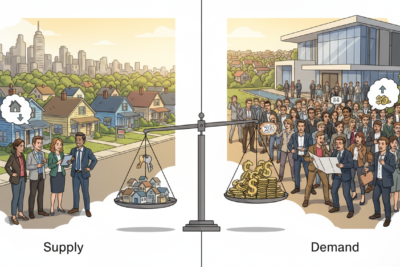
The balance between available homes and active buyers explains much of what you pay.
Supply and demand determine price when you shop for a house. Scarcity in desirable neighborhoods pushes values higher fast. Each property’s uniqueness also creates information gaps that complicate simple supply demand math.
Economists like Muth (1960) argue that housing should be seen as a bundle of services. That view helps you judge value beyond bricks and land.
- High transaction costs (1.5%–6% of the sale) slow trading and keep the market from clearing quickly.
- Local shortages, quality, and amenities explain why similar homes can have very different prices.
- Watching supply and demand trends helps you spot fair pricing in the broader housing market.
| Factor | Typical effect on price | Why it matters to you |
|---|---|---|
| Low supply | Price up | Less choice; higher competition |
| Strong demand | Price up | Quicker sales; bidding risk |
| High transaction costs | Less turnover | Harder to time moves |
| Service-value view (Muth) | Value varies by use | Assess long-term utility, not just size |
For a closer look at supply and demand in U.S. neighborhoods, read this supply and demand in the housing. To check affordability basics, see home affordability basics.
Interest Rates and Their Direct Impact on Mortgage Affordability
When central banks raise borrowing costs, your monthly housing payment can change faster than you expect.
Interest rates directly shape what you can borrow and how affordable a home feels. In 2024, global housing affordability fell about 15% after sustained rate hikes. That shift shows how sensitive mortgage budgets are to rate moves.
Below are the practical points you should consider before you lock a loan.
Fixed vs Adjustable Rates
With a fixed mortgage, your rate and payment stay the same for a set term. That gives you certainty and simpler budgeting.
An adjustable-rate loan starts lower but can rise with market rates. You accept more risk for a lower initial cost.
The Role of Commercial Banks
Commercial banks provide most home loans in the United States. Their lending policies set the supply of mortgage credit in the market.
When banks tighten underwriting, fewer buyers qualify and demand softens. That can slow price growth in local housing markets.
Mortgage Broker Influence
Mortgage brokers shop multiple lenders for your loan. They can compare products and sometimes find better rates than a single bank.
You should consult a broker if you want a quick view of options and a tailored loan recommendation.
- Rising rates cut affordability 15% drop in 2024 shows the impact.
- Choose fixed for predictability; adjustable if you accept future risk.
- Banks and brokers play a crucial role in moving mortgage capital to buyers.
- Talk to a professional broker to compare loan products before you sign.
Rising consumer prices usually ripple into housing, changing what buyers can afford.
Inflation often drives up construction and renovation costs. When materials and labor cost more, property prices tend to follow. That pressure raises estate prices across many neighborhoods.
High inflation can make it harder for first-time buyers to enter the market. Down payments and monthly payments feel larger when prices climb faster than wages.
Watch how interest rates react. Central banks raise rates to cool inflation, and higher rates raise borrowing costs. That change can slow demand and shift home prices.
- Plan a budget with buffer for rising property prices and higher rates.
- Compare fixed and adjustable loans so you understand rate risk.
- Review historical estate prices to see how inflation shaped affordability over time.
In short: track inflation and interest rates together. Doing so helps you time purchases and keeps your housing plan realistic in a changing market.
Government Legislation and Subsidies
Government rules and subsidies often steer who can afford to buy and where builders will build.
Policy shapes homeownership. Federal and state programs adjust the cost of buying through tax breaks and direct grants. These moves change demand for housing and the supply that developers bring to the market.
Tax Deductions and Credits
Tax deductions lower your taxable income, while credits cut what you owe. Together they can reduce the upfront and ongoing costs of owning a home.
- Look for first-time buyer credits and down payment assistance in your state to improve affordability.
- Mortgage interest and property tax deductions can ease annual costs and help your household budget.
- Local zoning and subsidy rules speed or slow new development, which then affects neighborhood supply and prices.
- Track changes in government law so you can claim credits and avoid surprises when you buy or sell.
Pro tip: consult a tax professional or housing counselor to apply credits correctly. Using available programs can lower your mortgage burden and make homeownership more achievable.
The Importance of Demographic Shifts in Housing Demand
Changes in who lives where alter demand for different types of homes.
Demographic trends population growth, household size, and age mix shape local housing demand over years. When more people move into an area, demand for housing usually rises and prices follow.
Research supports this link. De Leeuw (1971) found income elasticities for housing demand between 0.5 and 0.9 in North America. Polinsky and Ellwood (1979) estimated price elasticity near −0.7.
- Use local population data to spot areas likely to see housing growth.
- Age composition predicts whether demand favors single-family homes or apartments.
- Rising income often increases demand for services and larger units.
| Demographic Driver | Typical Effect on Market | What it means for your property choices |
|---|---|---|
| Population growth | Higher demand, price growth | Consider buying in fast-growing areas |
| Household size decline | More demand for smaller units | Multi-unit or condos may outperform |
| Income growth | Upshift in quality and size | Target neighborhoods with rising wages |
Actionable tip: Track local data each quarter. Early signals let you buy where people and income are rising, improving your chances of long-term growth.
Construction Costs and the Price of New Development
Construction costs drive how fast new housing appears and what new homes sell for. The National Association of Home Builders (NAHB) tracks materials, labor, and supply chain shifts that push builder budgets up or down.
When labor or material prices rise, developers pass those costs to buyers. That raises the price of new homes and, over time, lifts nearby estate prices as buyers compare old and new stock.
George Fallis (1985) found that supply can respond strongly over the long run, but not instantly. In the short term, the market stays tight because building takes time.
- Local building permits and new starts early signs that supply will increase.
- NAHB cost reports and headlines about lumber, steel, and labor shortages.
- Price differences between new builds and older homes in your target neighborhood.
| Driver | Short-term effect | Long-term effect |
|---|---|---|
| Rising material costs | Higher new-home prices | Pushes up nearby home values |
| Labor shortages | Slower construction | Delayed supply response |
| Increased permits | More upcoming supply | Can stabilize prices over years |
Evaluating Property Condition and Energy Efficiency
A property's visible finish rarely tells the whole story about future costs. You should inspect the structure, systems, and insulation before you agree to a price.
Why condition matters: hidden repairs can cut into value and raise your ongoing costs. A thorough check helps you compare properties fairly and spot needed work that will affect price and resale.
Energy Performance Certificates
Energy performance certificates show how efficient a property is. In the United States, efficiency ratings affect long-term utility bills and buyer demand.
Tip: favor homes with higher ratings. Better ratings usually mean lower monthly costs and stronger market value over time.
Renovation Costs
Estimate renovation costs before you buy. Factor in roofing, HVAC, windows, and insulation. These items shift price negotiations and can change your offer.
- Get contractor estimates for major systems.
- Prioritize upgrades that cut operating costs.
- Balance immediate fixes versus long-term improvements.
| Item | Typical Cost Range (US) | Effect on Value |
|---|---|---|
| Roof replacement | $5,000–$15,000 | Raises price; prevents leaks |
| HVAC upgrade | $3,500–$10,000 | Improves comfort; lowers energy costs |
| Insulation & windows | $2,000–$8,000 | Boosts efficiency; raises market value |
Bottom line: a careful inspection and realistic renovation budget reveal which housing options offer true value. This lets you choose properties that match your finances and long-term goals.
Global Economic Cycles and Currency Exchange Ratios
Shifts in world growth and manufacturing change how affordable property looks in your neighborhood.
Global output and GDP swings send waves through local markets. When global gdp growth slows, demand for U.S. homes from overseas buyers can drop, and you may see prices cool in some metro areas.
Currency moves matter for cross-border investment. A stronger dollar makes U.S. property more costly to foreign buyers. A weaker dollar can invite capital and push local prices higher.
High global inflation raises the cost of imported building materials. That lifts construction costs and eventually nudges housing prices upward.
"Watch GDP and currency trends they often signal when outside capital will flow into or out of local markets."
- Tip: monitor manufacturing activity and gdp reports to time an investment.
- Track currency strength to anticipate foreign buying cycles.
- Consider material import costs when estimating renovation budgets.
| Driver | How it moves markets | What you should watch |
|---|---|---|
| Global GDP | Alters demand from foreign investors | Quarterly growth and PMI reports |
| Currency exchange | Changes affordability for overseas buyers | Dollar index and FX headlines |
| Global inflation | Raises building and renovation costs | Commodity prices and shipping costs |
| Manufacturing activity | Signals trade and job trends that affect local demand | Factory orders and employment data |
For how cycles influence lending and timing across markets, read an industry primer on the understanding the real estate cycle.
Making Informed Decisions in a Changing Economic Landscape
You gain an edge when you combine reliable data with your personal income and mortgage plans, and then act with calm, clear steps.
Focus on long-term investment choices rather than short-term price swings. Track interest moves, local demand signals, and market trends so you spot opportunities before others do.
Always review your income, compare mortgage options, and use up-to-date data to test scenarios. The real estate market and the broader estate market change, but steady planning helps you find resilient opportunities.
FAQ
How do changes in GDP and job growth influence your property investments?
Economic growth and strong employment usually increase housing demand, rental activity, and long-term property appreciation.
What role do interest rates play in your mortgage affordability?
Interest rates directly impact monthly mortgage payments, loan qualification amounts, and overall borrowing costs.
How should you choose between fixed and adjustable mortgage rates?
Fixed rates provide payment stability, while adjustable rates may offer lower initial costs but greater long-term uncertainty.
How do commercial banks and mortgage brokers affect your loan options?
Banks offer direct lending products, while brokers compare multiple lenders to help you find competitive financing terms.
Why does inflation matter for your home’s value and operating costs?
Inflation can increase home prices, rental income, maintenance expenses, and long-term ownership costs.
How do supply and demand dynamics determine property prices in your area?
Limited housing supply and strong buyer demand usually push prices upward, while excess inventory may reduce values.
How do construction costs influence the price of new homes you might buy?
Higher labor and material costs often increase development expenses and raise the final selling price of new homes.
What impact do demographics have on the neighborhoods where you invest?
Population growth, migration trends, and household changes influence housing demand and neighborhood development patterns.
How do government policies and subsidies affect your ownership costs and incentives?
Tax incentives, subsidies, zoning changes, and housing policies can directly affect affordability and investment returns.
What tax deductions or credits should you watch to improve your after-tax returns?
Mortgage interest deductions, depreciation, energy-efficiency credits, and property tax deductions may improve net returns.
How does property condition and energy efficiency affect resale value?
Well-maintained and energy-efficient properties often attract more buyers, sell faster, and command higher market prices.
What are Energy Performance Certificates and why should you care?
Energy Performance Certificates evaluate building efficiency and can influence utility costs, resale value, and buyer interest.
How should you estimate renovation costs for a property you plan to buy?
Gather contractor estimates, include permit expenses, and budget extra funds for unexpected repairs or material increases.
How do global economic cycles and currency movements affect your investments if you own foreign property?
Economic slowdowns and currency fluctuations can impact rental demand, operating costs, and international property returns.
What is the stock and flow model and how does it apply to your housing decisions?
The stock represents total housing supply, while flow measures how quickly new units are added to the market.
How should you weigh property as both an investment and a consumption good?
Real estate provides housing and lifestyle benefits while also offering potential appreciation, rental income, and portfolio diversification.
How can you make informed choices in a rapidly changing market environment?
Track local market data, interest rates, inventory trends, and economic conditions before making long-term decisions.
What metrics should you track regularly to manage your property portfolio?
Monitor vacancy rates, cash flow, maintenance costs, rent growth, appreciation trends, and local inventory conditions.
If you want to know other articles similar to How Economic Factors Affecting Real Estate Impact You You can visit the category Real Estate.
Why Home Prices Change USA How It Affects Your Buying Power

Housing Market Basics USA for Beginners What to Expect
What You Need to Know About Supply and Demand in Housing USA

Real Estate Commission Explained USA What You Should Know

Buyer Agent vs Seller Agent USA Differences You Should Know

Benefits of Using a Real Estate Agent for Your Home
Leave a Reply
VISIT THESE INTERESTING ARTICLES📚