

What You Need to Know About Supply and Demand in Housing USA
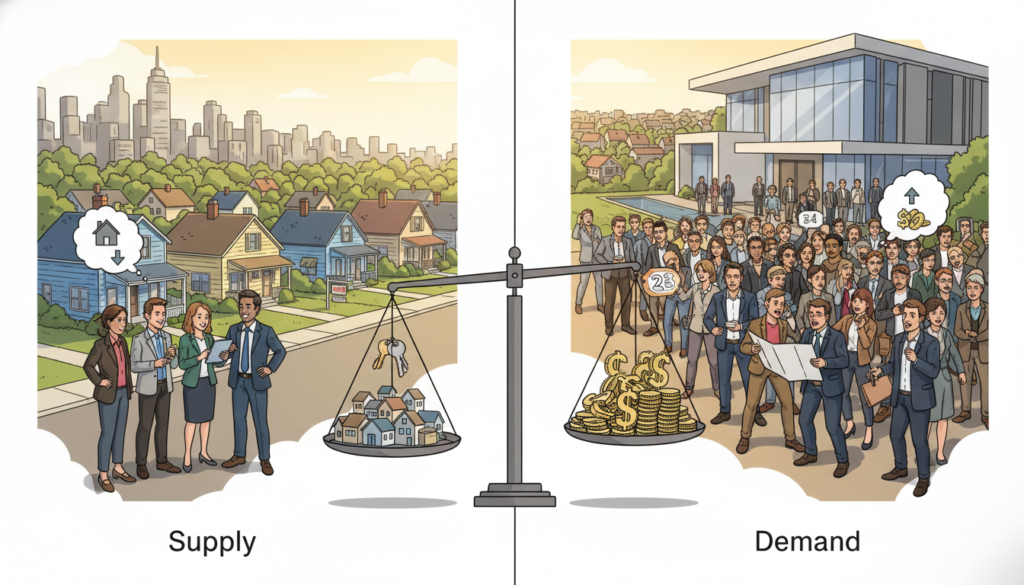
Have you ever wondered why home costs rose so quickly after past economic shifts?
This short guide explains the core forces that shaped the recent housing market in the united states. You will see how inventory levels, buyer behavior, and broader trends affected affordability. Understanding these factors helps you plan smarter for purchase timing and budgets.
We will walk through clear, practical reasons why imbalances lasted and what that meant for your options. Expect concise explanations that tie national trends to local outcomes. By the end, you should feel more confident about your next step in the home search process.
Table of Contents
- Understanding the Fundamentals of Supply and Demand in Housing USA
- The Historical Relationship Between Income and Home Prices
- Why Traditional Supply Constraints Do Not Tell the Whole Story
- The Role of Population Growth in Housing Development
- How Local Labor Markets Shape Housing Demand
- Distinguishing Between Demand for Quality and Demand for Units
- The Impact of Economic Growth on Regional Housing Markets
- Why Median Income Growth Often Lags Behind Home Prices
- The Connection Between Household Size and Housing Needs
- Evaluating the Economic Cost of the Current Housing Shortage
- How Zoning and Regulations Influence Local Construction
- The Influence of Federal Reserve Policies on Mortgage Rates
- Navigating the Current Housing Market as a Buyer
- Strategies for Long Term Property Investing
- Assessing Your Local Market Conditions
- Preparing for Future Shifts in the Real Estate Landscape
- FAQ
Understanding the Fundamentals of Supply and Demand in Housing USA

To navigate recent price shifts, you first need the basics of how the market balances itself. This short primer shows the forces that move local costs and what they mean for your search.
Defining Market Equilibrium
Market equilibrium happens when available homes roughly match what households are seeking. When balance holds, price pressure eases and transactions proceed more predictably.
The Impact of Scarcity
When available units lag behind buyer interest, scarcity raises price and creates tougher competition. Researchers used data from 321 metropolitan statistical areas to trace how these gaps change the national market.
Key takeaways: limited inventory pushes costs up; pockets with balanced listings show steadier price trends; understanding these patterns helps you time offers and set realistic budgets.
| Concept | Effect on Price | Example |
|---|---|---|
| Equilibrium | Stable prices | Neighborhood with steady listings and buyers |
| Scarcity | Rising price | Hot metro with few available homes |
| Surplus | Falling price | Area with many unsold units |
If you want a deeper policy view, read the state of the housing market. For practical buying steps, see this guide on how to buy a house.
The Historical Relationship Between Income and Home Prices

From the mid‑1970s through 2000, median income and home values rose on similar paths. Data from federal sources show the two tracked closely for about 25 years.
After the early 2000s a clear gap opened. Home price growth outpaced earnings, changing how you and many buyers evaluate affordability.
The 2008 financial crisis made matters worse. Post‑crisis income growth lagged while prices in many metros recovered faster. That shift left many households stretched for longer.
Understanding historic income growth is vital when you judge whether current housing costs are sustainable. Look at long‑run trends and local wages before you decide to buy.
- Key point: steady tracking until 2000, then divergence.
- Key point: the financial crisis amplified the gap between earnings and home prices.
Why Traditional Supply Constraints Do Not Tell the Whole Story
Evidence now points to multiple forces beyond building rules that shape local home affordability. Recent work shows you cannot blame one factor for high prices across all areas.
Challenging Common Assumptions
Louie, Mondragon, and Wieland (2025) use metro-level data to show that zoning and other regulations explain only part of the variation in prices.
Their analysis finds that construction activity sometimes rises without large price drops. That suggests other forces such as rapid income growth or regional amenities push values higher.
- The authors note zoning limits matter, but not always decisively.
- Income changes often track with persistent cost gaps.
- Active building does not guarantee better affordability for buyers.
For you, this means looking beyond local rules. Compare local wage trends, job growth, and market preferences before assuming more units will fix affordability.
The Role of Population Growth in Housing Development
Population shifts shape where builders focus new homes and which neighborhoods grow fastest.
Across about 85% of metro areas between 2000 and 2020, the number of new units rose faster than local population. That data shows construction often followed historic migration and job trends rather than leading them.
Still, the link between people and added units is not perfectly linear. At times developers build more than immediate needs, while other moments show a lag where growth outpaces new development.
For your planning, this means looking at both recent demographic moves and planned projects. Watch whether local development targets match where jobs and households are actually growing.
- Population trends help predict where new housing supply will be needed.
- Even expensive metros often expand units because of local demographic shifts.
- See detailed population trends to align your search with likely development paths.
How Local Labor Markets Shape Housing Demand
Job mix and wage gains are key drivers behind many recent regional price moves. You need to watch which occupations expand near you. That tells you what buyers will pay for and where builders aim projects.
High-Skill Job Growth
When tech, finance, or specialized healthcare roles grow, higher wages follow. That often pushes up local prices quickly.
Result: greater demand for quality units and tighter housing supply in popular neighborhoods.
Middle Income Employment Trends
Areas with more middle-income jobs show different patterns. Builders may add more units that match practical budgets.
David Autor's 2019 work notes the hollowing out of middle-skill roles. That shift changes how many households can compete for mid-tier homes.
- High-skill growth → concentrated price spikes.
- Broad middle-income growth → steadier demand and more balanced construction activity.
- Analyzing local labor trends helps predict how income changes will affect both housing demand and unit types.
| Labor Pattern | Typical Price Effect | Housing Demand | Construction Response |
|---|---|---|---|
| High-skill surge | Sharp rise | Luxury and small-unit demand | Targeted, limited new builds |
| Middle-income growth | Moderate rise | Family-sized and affordable units | Broader, larger-scale construction |
| Job loss or hollowing | Flat or falling | Lower demand for higher-end units | Reduced building activity |
Distinguishing Between Demand for Quality and Demand for Units
Distinguishing whether buyers want larger units or higher finishes helps explain puzzling local price trends.
When household income rises, many buyers move toward higher-quality finishes, not just more units. This shift pushes up the price for well-located, upgraded homes even where the total housing supply stays steady.
Other areas see growth tied mainly to added units from migration and new construction. There, the number of dwellings grows faster than costs. You must spot which pattern fits your metro to set realistic expectations.
Ask whether buyers want space or amenities. That simple question clarifies why some neighborhoods show rising prices without more listings available to most households.
| Type of Buyer Priority | Typical Effect on Price | Common Response |
|---|---|---|
| Quality (upgrades, amenities) | Sharp local price gains | Renovations, niche new builds |
| Units (more homes, larger count) | Moderate or stable prices | Broad construction, higher vacancy |
| Mixed (income growth plus migration) | Variable costs by area | Targeted development and resale activity |
For policy detail on how these forces interact with regional markets, see the Federal Reserve working paper on local trends and the practical guide to timing a sale for sellers considering market signals.
Fed working paper on regional housing · best time to sell a house
The Impact of Economic Growth on Regional Housing Markets
Strong local growth often turns quiet neighborhoods into competitive markets within a short span. You see higher prices where payrolls rise and new firms cluster near transit or tech hubs.
Research shows average income growth tracks closely with house price growth across many metro areas. That one‑for‑one movement explains why some regions post faster price gains than others.
When income climbs rapidly, housing demand rises too. That trend tightens affordability for middle‑income families and pushes builders toward higher‑end units more often than starter homes.
- Economic booms raise buyer activity and overall market interest.
- Areas with steady wage gains tend to see faster price appreciation.
- Watching local job rates, wage data, and permit filings helps you judge future trends.
Actionable point: track income, employment growth, and permit activity near your target metro to judge how growth will shape local prices and affordability.
Why Median Income Growth Often Lags Behind Home Prices
A clear split emerged after 2000: earnings for most families trailed sharp home price gains. This gap reshaped who could afford to buy, and where.
The Divergence Since the Turn of the Century
From 2000 to 2024, house price growth far outpaced median income growth. The result: many households face tighter budgets when shopping for a home.
Key reasons for the gap:
- Income growth concentrated at the top while median wages stayed flat for many workers.
- Average income metrics can mask the struggles of typical households, making affordability worse than headline numbers suggest.
- Data from the Federal Housing Finance Agency show sustained drift between these two measures over two decades.
Understanding this divergence helps you judge local market trends and affordability risks. For a detailed review of how home prices outpaced wage gains, see this analysis on home prices and income.
The Connection Between Household Size and Housing Needs
Household size shapes how many homes a community needs and what unit types will succeed.
Larger families often need more rooms and outdoor space. This shifts local housing preferences toward bigger units and multi‑bedroom homes. Smaller households raise the total demand for units because one household no longer equals more people under one roof.
When income rises, many people choose to form smaller households. That trend increases the number of households per area and the overall demand for residences.
"Demographic change can drive more unit-level needs even when population growth slows."
Recent data show that after a certain household size, extra income rarely creates more units. Households instead spend on location or higher quality finishes. That shift creates stronger market demand for renovated homes and prime addresses rather than just more square footage.
- Larger households → more space per unit.
- Smaller households → higher unit counts per person.
- Quality or location often wins over quantity once basic needs are met.
| Household Trend | Typical Effect | Policy or Market Response |
|---|---|---|
| Growing household size | Need for larger units | Build family homes, add schools |
| Shrinking household size | More units needed | Smaller apartments, more rental stock |
| Stable size with income growth | Shift to quality/location | Renovation, premium developments |
Understanding the link between household number and needs helps you predict local market shifts. Watch household composition, wage trends, and age levels for clearer signals about future unit growth.
Evaluating the Economic Cost of the Current Housing Shortage
A persistent shortfall of homes now carries a clear price tag for regional economies. The best recent estimates put the shortage at over 4.7 million homes across the united states.
This gap grew after the 2008 financial crisis and has cut into growth, labor mobility, and local output. Businesses struggle to recruit when workers cannot find affordable places to live near jobs.
Look at the data on GDP losses to see the scale. Underbuilding relative to historical levels lowers consumer spending and slows expansion.
- The shortage has produced measurable economic losses for many states.
- Reduced mobility raises hiring costs and limits firm growth in key areas.
- Fixing the supply demand gap is central to restoring affordability for households at all income levels.
In short, the crisis is not just about rising prices. It affects jobs, wages, and long‑term economic health. You should weigh these costs when assessing local market plans or policy options.
How Zoning and Regulations Influence Local Construction
Local codes and permitting timelines frequently determine whether new projects ever reach completion. These rules shape what you see built near jobs, transit, schools.
Zoning can limit lot size, heights, or use. That reduces how many homes developers can add on a single site. Strict rules also raise upfront costs and slow approval.
Data across metro areas show a mixed picture. Some places with tight rules still saw rapid growth, while others with lenient standards kept prices high. The link between regulations and price is complex.
- Restrictive zoning may worsen a shortage by capping units per parcel.
- Permit delays raise project costs, which pass to buyers.
- Targeted reform can improve affordability but won’t fix every local issue.
For you, understanding local policies helps align development goals with realistic outcomes for construction, income trends, and long-term affordability.
The Influence of Federal Reserve Policies on Mortgage Rates
Rate decisions from the Federal Reserve can turn an affordable market into a strained one within months.
When the Federal Reserve raises interest, mortgage rates tend to climb. That change raises monthly payments and reduces how much you can borrow.
The knock-on effect touches both buyers and builders. Higher rates make new construction costlier because developers pay more to finance projects. That slows additions to local housing supply and can push prices up where units are limited.
Historical data show mortgage benchmarks shift after Fed moves. Even modest rate hikes alter affordability for many households and slow price growth across metros that earlier enjoyed strong income gains.
Watch Fed statements and key economic reports. By tracking policy signals you can better time purchases, lock loan terms, or pause bidding when rates spike.
- Tip: Monitor federal reserve announcements for clues on future rates.
- Tip: Compare fixed versus adjustable mortgage offers when interest trends rise.
Today's market asks buyers to move with data not impulse as rates and available homes shift rapidly.
Understand the new normal: since the pandemic began, supply and demand patterns changed. High mortgage rates and a persistent shortage have made homeownership tougher for many buyers.
Monitor local home prices and interest trends before you bid. Small rate moves can change your monthly payment and how much you can borrow.
"Expect a longer search and sharper competition; plan your budget and priorities before offers land."
- Track recent home prices, nearby listings, and mortgage rates.
- Set a clear maximum budget and preapproval before house hunting.
- Work with a real estate professional to evaluate offers and long-term financing.
| Focus Area | Buyer Action | Why it Matters |
|---|---|---|
| Local prices | Watch weekly listings | Shows competition level |
| Interest rates | Lock when terms fit | Affects monthly cost |
| Inventory | Broaden search radius | Improves chances to find homes |
Strategies for Long Term Property Investing
Smart investors pick neighborhoods using clear data about local market trends. Use recent population shifts, job growth, and listing activity to spot areas with steady housing demand.
Focus on income growth along with price trends when you evaluate a property. Location matters most for long-term value, so weigh schools, transit, and nearby employers.
Mortgage rates and interest costs affect cash flow, but they rarely change a property's long-run appreciation alone. Plan for a multi-year horizon and expect cycles.
Set a written plan that matches your time goals. Decide how long you will hold, what return you need, and how you will handle vacancies or repairs. That clarity helps you act like a disciplined buyer.
| Strategy | Why it Matters | Action |
|---|---|---|
| Market fundamentals | Shows sustainable growth | Track job, income, and permit data |
| Location quality | Drives long-run prices | Choose proximity to transit and employers |
| Rate sensitivity | Affects cash flow | Stress-test with higher rates |
| Holding time | Reduces short-term risk | Plan for multi-year ownership |
"A clear strategy helps you navigate ups and downs while keeping focus on returns."
Assessing Your Local Market Conditions
You can judge local conditions quickly by tracking listing counts, median prices, and time-to-sale trends. Start with recent weekly data to see whether listings are rising or falling.
Look at three core metrics: number of new listings, median home price, and average days on market. These show how fast prices move and how tight unit availability feels.
Since the pandemic many people moved across state lines. That shift altered local market growth and changed which areas saw quick increases.
Track mortgage rates and interest costs closely. Rising rates cut what buyers can afford and often slows growth within weeks.
| Metric | Why it matters | How to use data |
|---|---|---|
| New listings | Shows current availability | Compare month-over-month |
| Median price | Reflects local price trends | Watch for sudden jumps |
| Days on market | Indicates buyer activity | Short periods mean quick action |
Check state-level reports to see how your metro stacks against broader trends. If a local shortage is clear, be ready to act when a suitable home appears.
Preparing for Future Shifts in the Real Estate Landscape
Stay ready: small moves in rates or migration can shift your position faster than expected.
Watch long-term trends for population growth and local housing projects so you can prepare for future market change across your state.
Data show the supply demand gap and the ongoing shortage will shape home costs for many people. Build buffers in your budget to handle rate swings and unexpected repairs.
Even after the pandemic, remote work and new preferences affect homeownership choices. Use up-to-date data to test scenarios before you buy.
Bottom line: keep a clear plan, monitor key metrics, and act when trends align with your goals to weather the next market shift or crisis.
FAQ
What do you need to know about supply and demand in housing USA?
Home prices are heavily influenced by the balance between available inventory and active buyer demand in local markets.
How do you define market equilibrium for homes?
Market equilibrium occurs when housing supply matches buyer demand at current price levels without strong upward or downward pressure.
What is the impact of scarcity on home prices?
Limited inventory and slow construction often increase competition among buyers and push home prices higher.
How has the relationship between income and home prices changed historically?
In many regions, housing prices have increased faster than wages, reducing affordability for middle-income households.
Why don't traditional constraints explain the whole problem?
Beyond land and regulations, financing conditions, labor shortages, investor activity, and development economics also shape housing markets.
What common assumptions about construction and costs should you challenge?
New construction does not always lower prices immediately, especially when labor shortages and material costs remain high.
What role does population growth play in development?
Population growth increases housing demand and can place upward pressure on prices when supply cannot keep pace.
How do local labor markets affect buyer interest?
Strong job growth attracts workers and increases housing demand, while weaker labor markets may reduce buyer activity.
What happens when high-skill job growth accelerates?
High-income job growth often boosts demand for premium housing and raises prices in desirable urban areas.
How do middle-income employment trends influence markets?
Changes in middle-income employment directly affect demand for entry-level homes, rentals, and affordable housing options.
How do you distinguish between demand for quality versus demand for units?
Some buyers seek luxury features and amenities, while others simply need affordable housing availability and accessibility.
How does economic growth shape regional real estate?
Strong economic expansion usually increases housing demand, investment activity, and long-term appreciation potential.
Why does median income often lag behind home prices?
Housing markets can rise quickly due to low inventory and investor demand, while wage growth typically moves more slowly.
What is the divergence since the turn of the century?
Since 2000, many major metropolitan areas have experienced home price growth that significantly exceeded wage growth.
How does household size affect housing needs?
Larger households require bigger homes, while smaller households increase demand for apartments and compact living spaces.
How do you evaluate the economic cost of the current shortage?
Housing shortages increase living costs, reduce mobility, and can negatively impact productivity and labor market flexibility.
How do zoning and regulations shape new construction?
Zoning laws control density, building types, and approvals, directly influencing how quickly new housing can be developed.
How do Federal Reserve policies influence mortgage rates?
Federal Reserve policy affects interest rates, which directly influence mortgage affordability and buyer purchasing power.
How should you approach the current market as a buyer?
Focus on affordability, financing terms, local inventory, and long-term value before making a purchasing decision.
What strategies work for long-term property investing?
Long-term investors often prioritize cash flow, strong local economies, limited inventory growth, and diversified holdings.
How can you assess your local conditions effectively?
Monitor inventory levels, vacancy rates, permit activity, local pricing trends, and economic development within your region.
How do you prepare for future shifts in the real estate landscape?
Stay informed about demographic changes, interest rates, zoning reforms, and evolving work and housing trends.
If you want to know other articles similar to What You Need to Know About Supply and Demand in Housing USA You can visit the category Real Estate.
Real Estate Commission Explained USA What You Should Know

Buyer Agent vs Seller Agent USA Differences You Should Know

Benefits of Using a Real Estate Agent for Your Home

Questions to Ask Your Property Agent Before Buying

Real Estate Agents Role USA and How It Helps Your Home Search

How to Choose an Agent USA Tips for Smart Property Buying
Leave a Reply
VISIT THESE INTERESTING ARTICLES📚